And breathe. The most down-to-the-wire Scottish Premiership season has finally reached its conclusion: the status-quo has won again.
Celtic did not make it easy for themselves, but have ultimately come out on top for the fifth time in a row, setting the bar high for their league rivals who can now only dream of lifting the Premiership trophy.
After a turbulent 33 regular-season games, Celtic needed to win all five Top 6 split games to have any chance of retaining the title.
Football is a team sport, no arguing there. But in times like these, individual elite brilliance can be that difference maker between champions and second-place.
Celtic’s season had been riddled with injuries to key players (Cameron Carter-Vickers, Jota, Alistair Johnston, Kasper Schmeichel, and Julián Araújo, just to name a few).
If Celtic were to come back and win this league, they’d need a hero.
Step up: Daizen Maeda.
5 games to go. All in for the title. pic.twitter.com/NAOirqsK9x
— 前田 大然 Daizen Maeda (@M_daizen_1020) April 26, 2026
From the start of the season in early-August to the last game of 2025 in late-December, Maeda’s goal scoring record largely matched his expected goals (xG).
Across this span in the season, Daizen’s difference in xG to actual goal scoring output was negligible — he was producing roughly as expected.
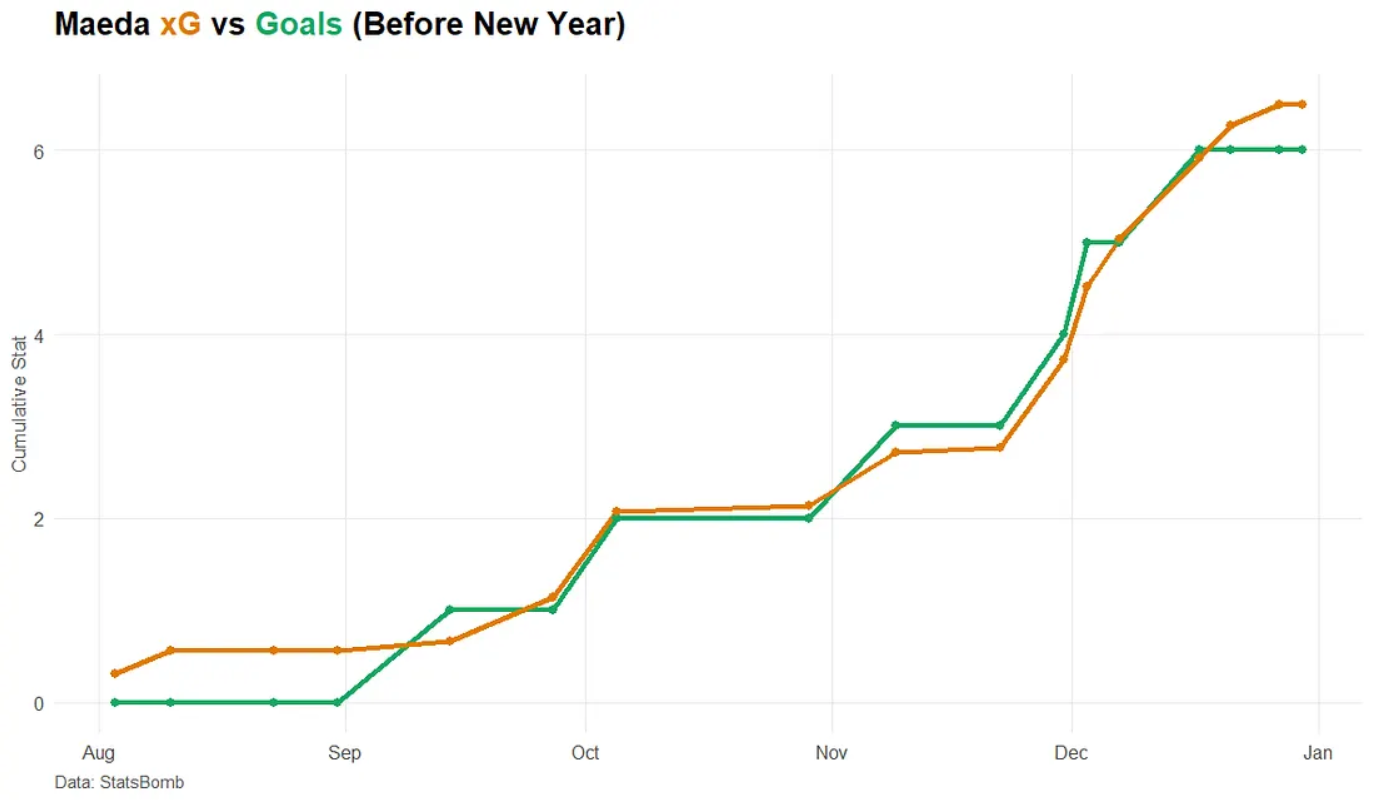
But this was not the case for those last 4 games in December. His goal scoring suddenly flatlined whilst xG was still climbing, foreshadowing for what was to come in 2026.
From 1 January up until the Premiership split, Celtic’s Blue Samauri would only convert 1 goal in 14 matches. His xG was predicting him to have tallied up at least 4 in the same timeframe.
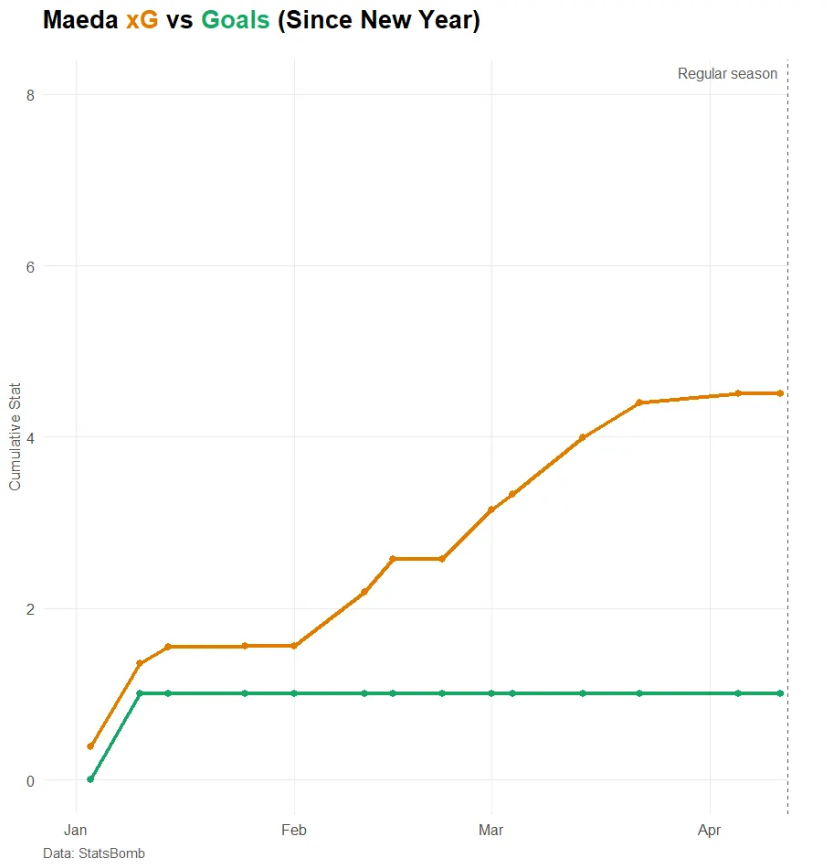
Celtic would enter the split in 3rd place, three points behind leaders Hearts.
It was at this point a switch flipped inside Daizen Maeda. He was now a man on a mission.
Before the split, Maeda was underperforming his 2026 xG by around 3 goals, yet he’d finish the post-New Year half of the season overperforming in this stat.
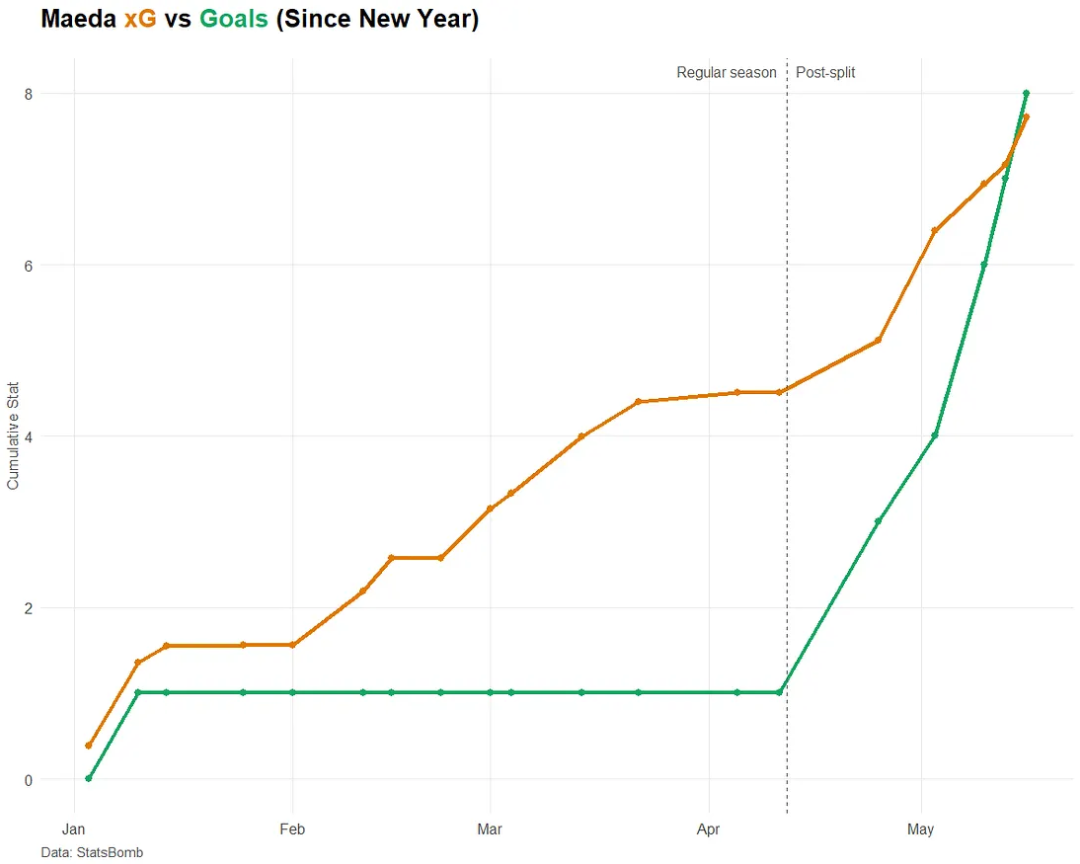
Seven goals in five games.
Maeda’s shot map shows his finishing was polished post-split.
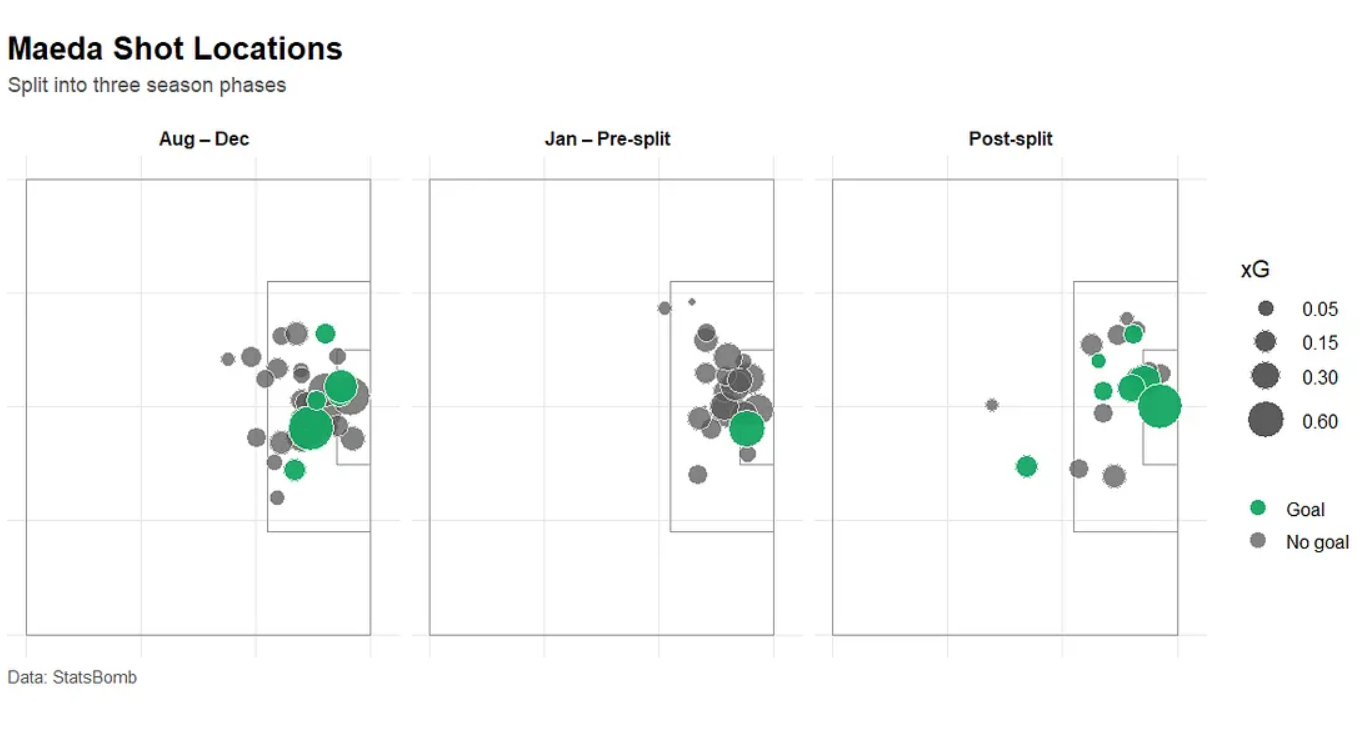
His post-split shots weren’t from better positions, they were largely from the same zones he occupied all season.
His chances didn’t get easier, but the finishing was more clinical.
So, what does this tell us? Well, we can view it two ways.
This can be seen as an elite player generating high-quality chances that eventually converted them. The goals were always coming, they just clustered perfectly at crunch time. Regression to the mean.
But we can also view this as Maeda shifting into another gear.
Maeda’s trademark relentless, high-intensity pressing supports this narrative. His numbers reached a new level during the split.

Pressures per match averaged just below 21 across the regular season, but would average at 26.2 pressures per match during the split.
Pressures specifically into the final third also peaked during the split, at 14.2 per match on average.
Finally, Maeda would average more recoveries in the opposition half post-split (2.4) than in any phase before.
If this were pure regression, we’d expect his off-ball numbers to look the same as before. They don’t.
Pressures, final third pressures, and ball recoveries in the opposition half all jumped during the split. Maeda didn’t just convert better; he played at a higher intensity in the moments leading up to the chances.
Daizen Maeda is going to be sorely missed when he inevitably leaves this summer, but he has earned his chance to experience something else and go with our blessing. The guy turned on the style and dragged us to the title. While others weren’t scoring, he stepped up big time. 💚 pic.twitter.com/QwEOiNTwzy
— The Parkhead Faithful (@TheParkheadF) May 17, 2026
While others weren’t scoring, he stepped up big time.
xG said the goals were coming. Maeda made sure they came right as Celtic needed them.
Whether you read his post-split run as regression to the mean or a player shifting up a gear, the answer doesn’t actually change what we witnessed: a striker whose pressing numbers reached a new level at the right time, who converted his chances when they mattered most, scoring seven in five when his team desperately needed it.
Celtic kept the faith through his 14-game goal drought. The xG numbers showed that he’d come through.
They got their reward.