Points Above Replacement

Overview

Adapted from baseball's Wins Above Replacement (WAR), my MSc Sport Data Analytics dissertation looked to build a Points Above Replacement (PAR) metric. This is a transparent, reproducible player valuation model for outfield players across Europe's top seven leagues, built entirely from publicly available box-score data.

The final metric expresses each player's full-season contribution as the number of league points they add above a freely available replacement in their position.

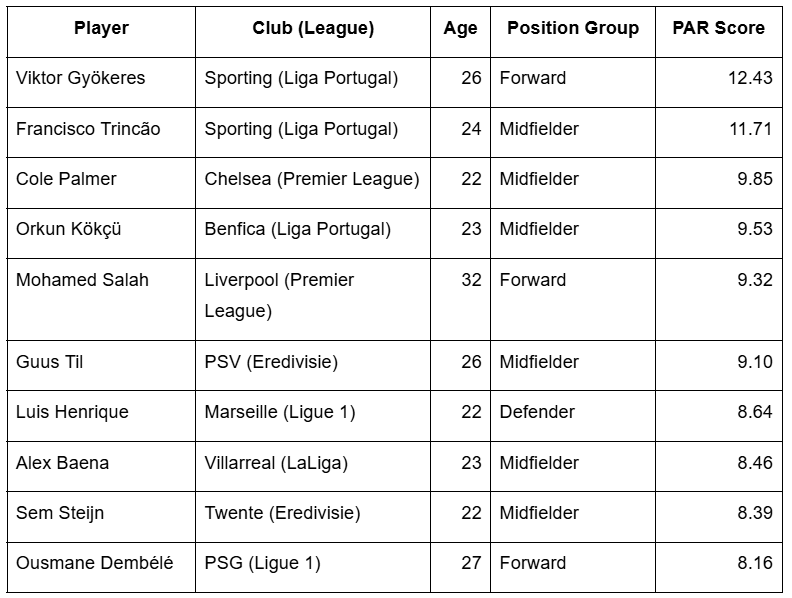
Across a sample of 1,959 outfield players from the 2024/25 season, PAR identified Viktor Gyökeres, Francisco Trincão, Cole Palmer, Orkun Kökçü, and Mohamed Salah as the five highest-value performers.

Motivation

Modern player valuation models tend to depend on proprietary tracking event data, available only to elite clubs and specialist vendors. Independent researchers, smaller clubs, and analysts operating outside the elite tier are effectively locked out.

PAR builds a rigorous, position-aware player valuation metric from box-score data alone so the underlying methodology is fully inspectable and reproducible.

The closest public relative (American Soccer Analysis' PAR) relies on Major League Soccer's public wage data to define replacement level, which does not transfer to European leagues where reliable wage data is scarce. This dissertation aimed to fill that gap.

The Dataset

The data used was sourced from FBref's 2024/25 advanced statistics for Europe's top seven leagues (as per UEFA coefficients). Goalkeepers were excluded because their contribution rests on a largely distinct skillset that would demand separate modelling.

A minimum threshold of 900 minutes (ten full matches) was applied to ensure per-90 rate statistics were estimated from a stable sample. This reduced the raw pool of 3,679 outfielders to a final analytical sample of 1,959 players: 817 defenders, 662 midfielders, and 480 forwards.
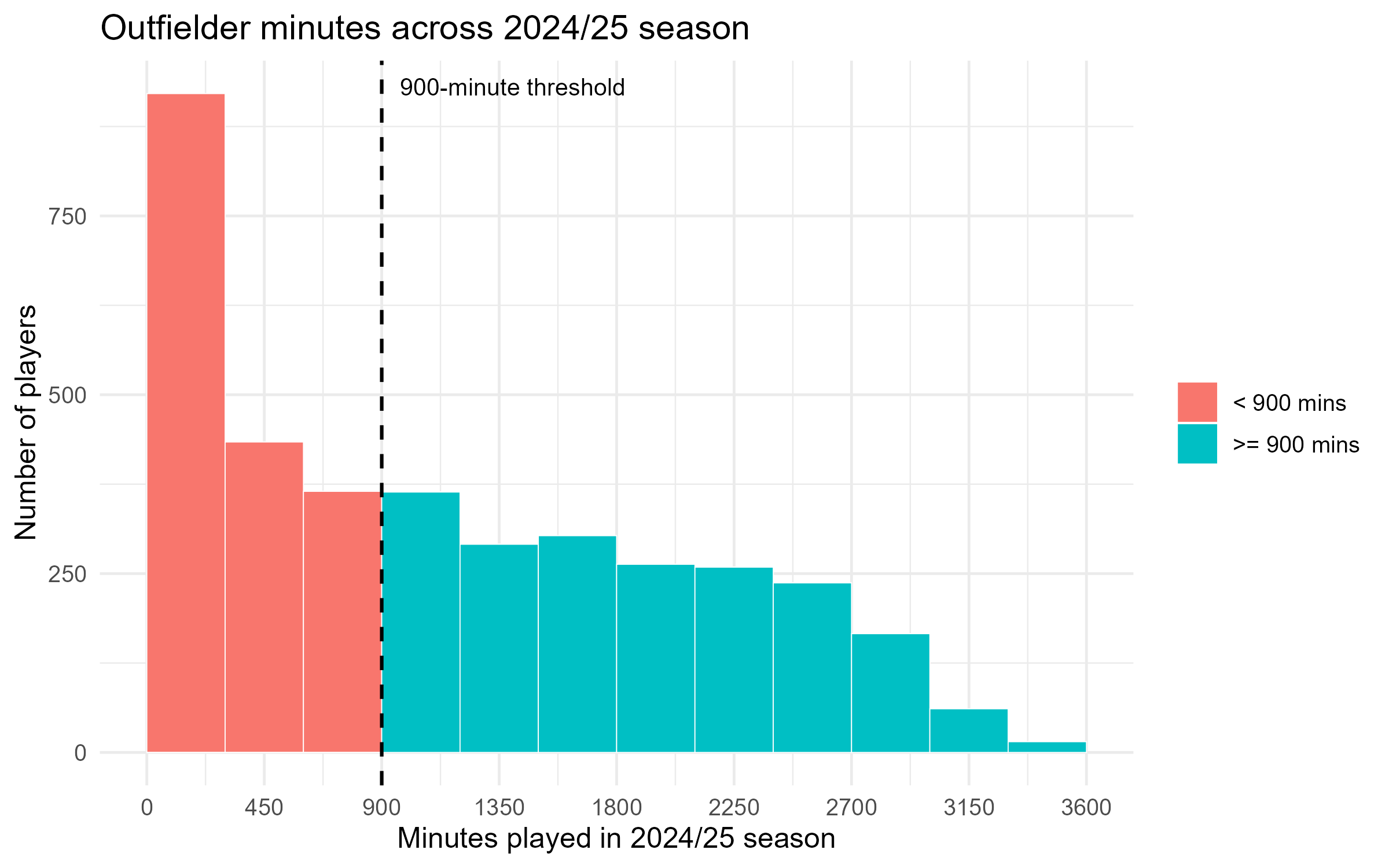
Histogram of entire dataset, cut-off set at 900 minutes

Methodology

Exploratory factor analysis with oblique rotation reduced over 100 performance variables to just ten interpretable playing-style factors.

The ten playing-style factors were:

Each player's factor scores were then aggregated to team level and regressed against team goals scored and goals conceded. The resulting weights were applied back to individual players to estimate their per-90 contribution to net goal difference.

Position-specific replacement baselines were established from players at each league's bottom three teams. From there, each player's goal-difference contribution above replacement was converted into league points using five-season, league-specific points-per-goal-difference coefficients.

Findings

Full-season PAR is topped by two Sporting Lisbon players, Viktor Gyökeres (12.43) and Francisco Trincão (11.71).

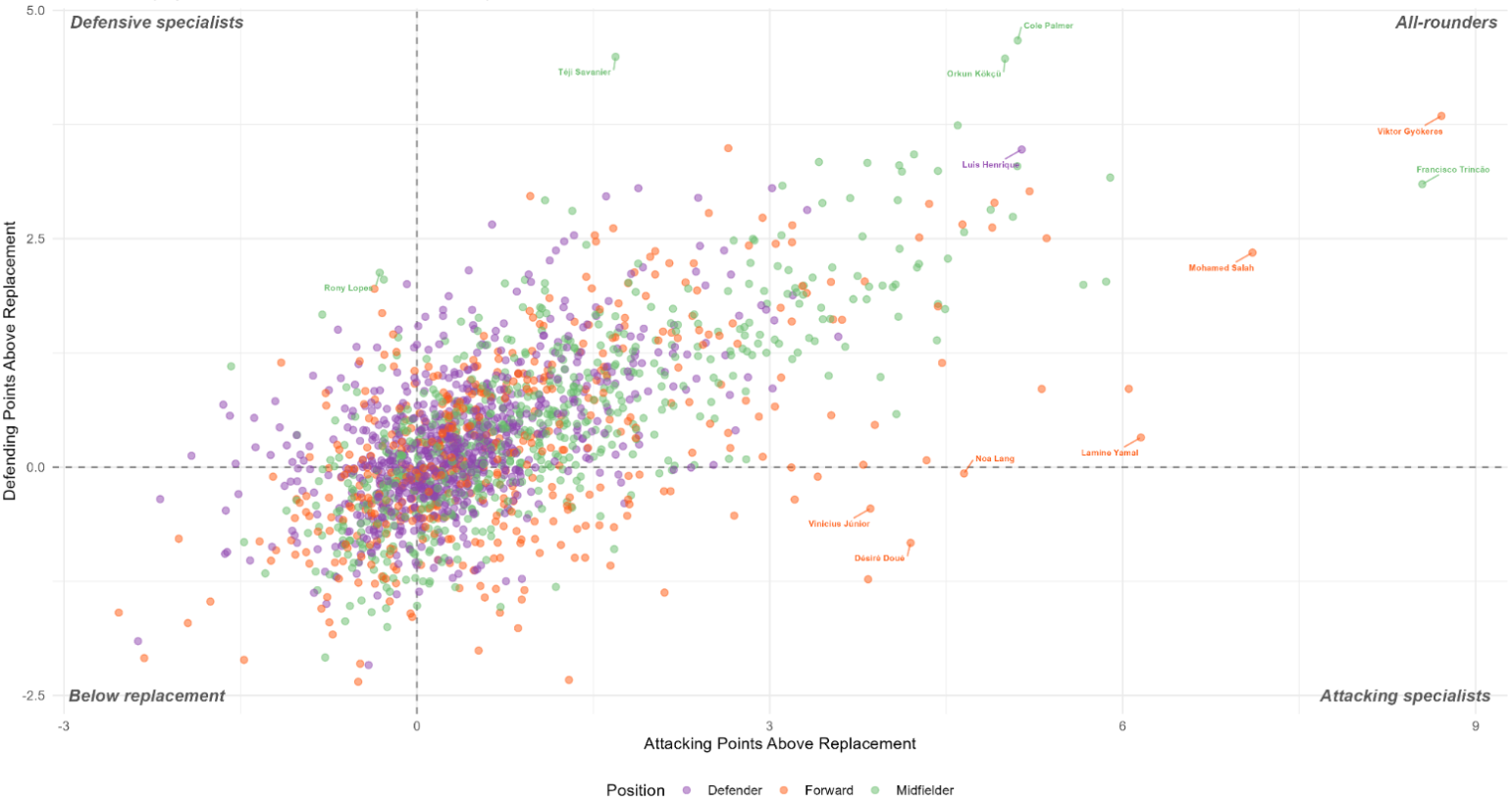
Quadrant chart of all PAR scores

Splitting the sample into "All-Rounder", "Attacking Specialist", and "Defensive Specialist" quadrants shows that 52% of players contribute above replacement in both defensive and attacking PAR.
Leicester City's Harry Winks was found to be the most replacement-level player (0.07).

PAR measures each player against a replacement in their own league, so strong players in less competitive leagues are shown accumulate the largest totals.

Top 10 PAR scorers
Top 10 PAR scorers

Limitations

The single biggest limitation is that PAR is poor at valuing defenders. The goals-conceded regression explains only 41% of team variance, compared with 92% for goals scored. This is not a fault of the pipeline, it is a general limitation of box-score data. A defender's PAR should therefore be read as a broad indication rather than a precise ranking.

Similarly, only three outfield position groups are used, so centre-backs and full-backs are treated identically as are wingers to strikers.

The metric was only modelled on a single season.